
From dodging global oil shocks to cleaning up our air, here are twelve powerful reasons why swapping fuel for electric plugs is a smart move for South Africa.
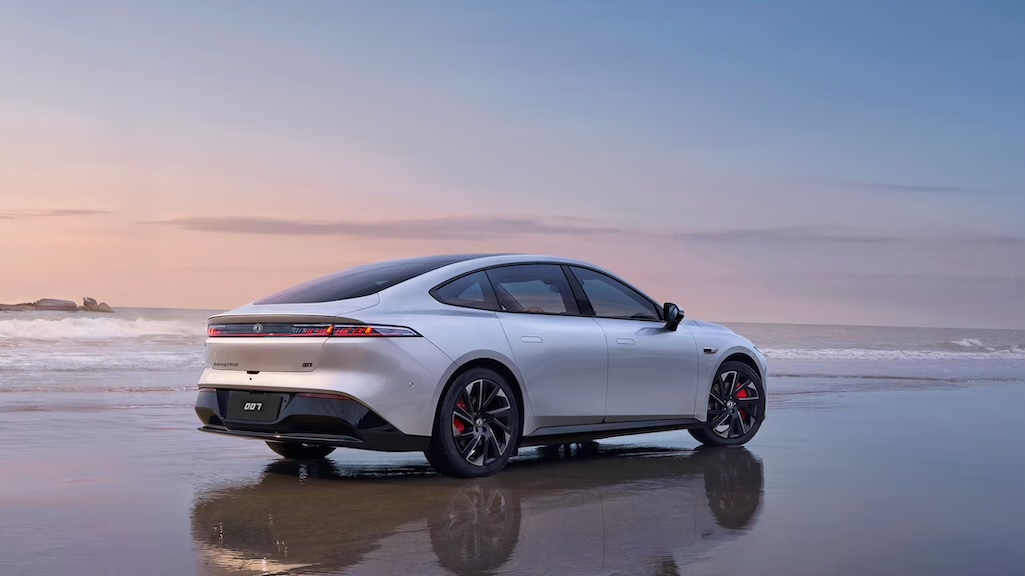
South Africans started October 2026 paying more for fuel than ever before: R30.25 a litre for petrol 95 inland and R33.29 for 50 ppm diesel. Buyers are responding. Hybrid and electric sales for January to August reached a combined 18 945 units, 13.4% more than in the whole of 2025. An analysis of NAAMSA data by the International Council on Clean Transportation (ICCT) shows 3 217 battery electric vehicles sold in the year to September, more than in any previous full year. The true figure is higher, because Geely and Dongfeng do not report to NAAMSA.
“South Africans aren’t waiting for government policy to catch up. Sales of battery electric vehicles this year have almost tripled last year’s sales figures, with a full quarter still to go,” says Prian Reddy, senior researcher at the ICCT. “People can see that electric vehicles protect them from fuel price spikes. But we’re still taxing electric vehicles as luxury goods, which prices out many South Africans from purchasing them,” he adds.
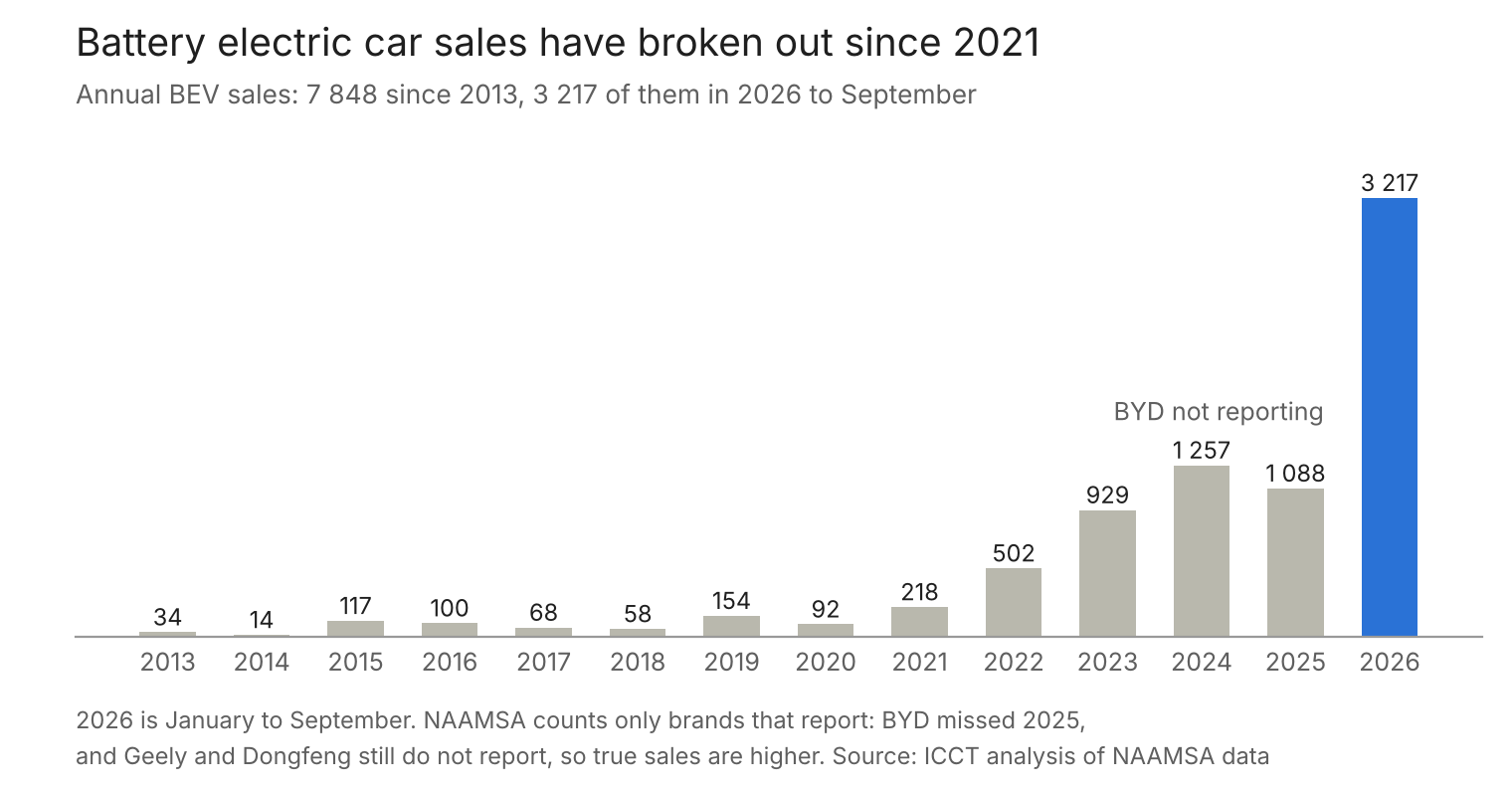
ICCT analysis of NAAMSA data (Prian Reddy) · annual BEV sales, 2013 to September 2026
1. Protection from someone else’s war
The price at a South African pump is set mostly in foreign markets, in dollars, under import parity pricing. That is why petrol 95 has risen by a net R10 a litre and diesel by R15 a litre since the US attacked Iran at the end of February 2026. An electric car runs on energy that is produced in South Africa and priced by a domestic regulator. Electricity prices also go up, but they go up once a year by a published percentage rather than monthly because of events in the Strait of Hormuz.

2. A smaller import bill and a sturdier rand
The fuel shock has cost the whole economy, not only motorists. Research by CREA estimates that South Africa paid about R56 billion extra for fossil fuel imports between March and August 2026, equal to 0.88% of GDP, with diesel and gasoil accounting for roughly R33.9 billion of that excess burden. The structural problem predates the war. South Africa’s refining capacity has halved over the past decade, so imported refined products now meet more than half of local demand. The resulting external deficits weaken the rand and make every import more expensive. Each litre that is not imported eases that pressure.
3. Much lower running costs per kilometre
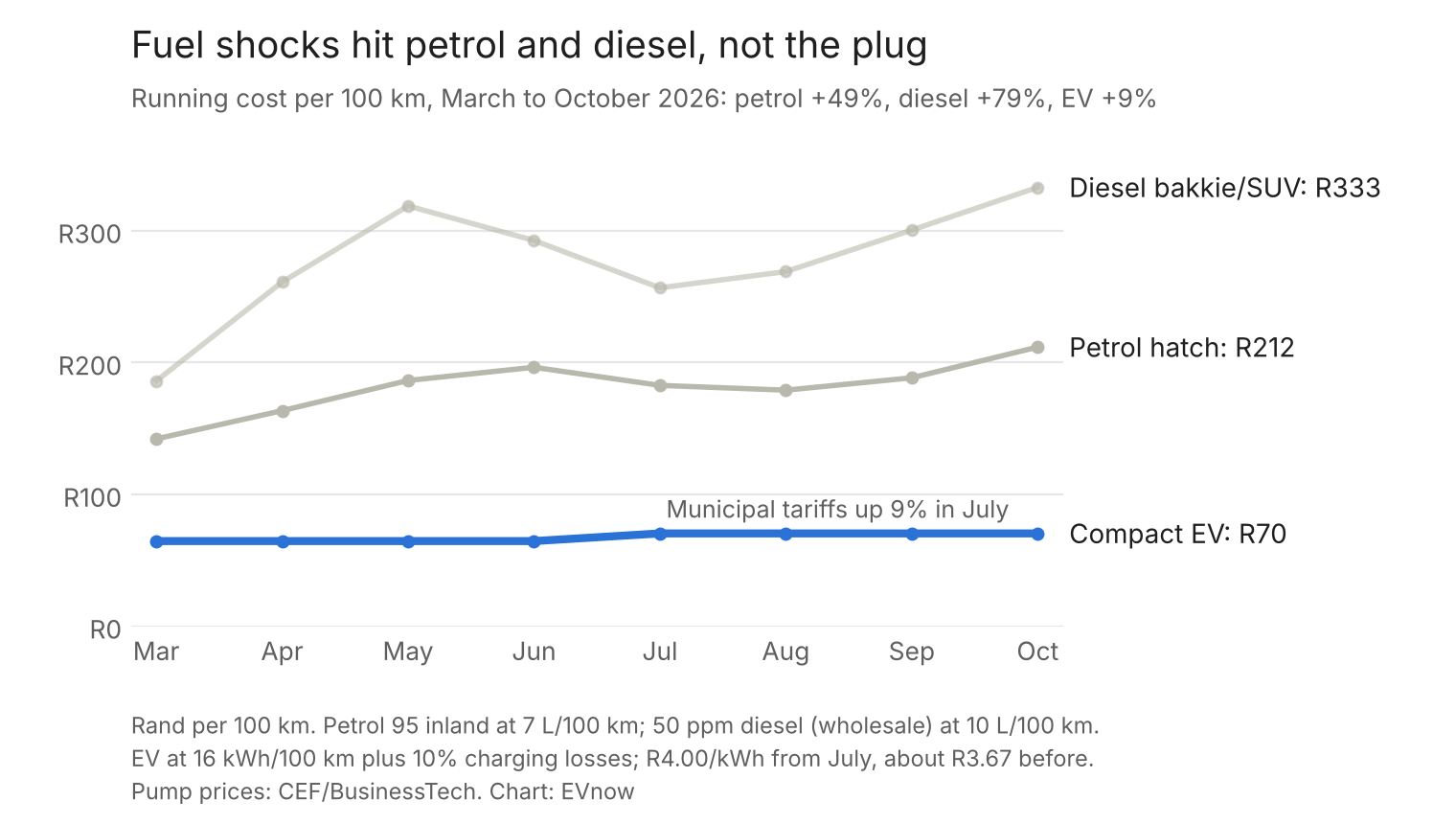
A petrol hatchback using 7 litres per 100 km costs about R212 per 100 km at inland prices. A diesel bakkie or SUV using 10 litres per 100 km costs about R333. By comparison, a compact EV using 16 kWh per 100 km, charged at home at a R4.00/kWh tariff with 10% charging losses, costs roughly R70, a third of the petrol hatch. An electric SUV using 20 kWh per 100 km costs about R88, roughly a quarter of the diesel figure.
R4.00/kWh is a realistic urban benchmark: as of July 2026, eThekwini charges R4.17/kWh and Johannesburg’s top prepaid block reaches R4.36/kWh. Electricity tariffs will keep rising, with an 8.83% Eskom increase approved for April 2027, but rates would have to nearly triple before an EV costs the same per kilometre as a petrol equivalent. Owners charging from rooftop solar during the day pay even less.
4. Less fiscal firefighting
Every fuel spike forces the Treasury to choose between hurting motorists and surrendering revenue. Previous fuel levy reductions cost the government roughly R17 billion in lost revenue, and Parliament is currently processing a bill to transfer R10 billion to the Department of Mineral and Petroleum Resources to stabilise fuel costs. A fleet less reliant on oil reduces the need for emergency fiscal relief, preserving public funds for healthcare, rail, electricity transmission, or public co-funding of charging infrastructure.
5. Less fuel-driven inflation
Fuel influences the price of nearly all goods. Because over 70% of freight in South Africa moves by road, diesel spikes filter directly into food prices weeks later. Electrifying urban delivery fleets, buses and minibus taxis would decouple transport costs from global oil shocks, helping insulate domestic inflation and interest rates from foreign market volatility.

6. Fewer early deaths
According to ICCT research, road transport pollution in South Africa causes about 2 320 premature deaths and 660 new cases of childhood asthma annually. A key driver is regulatory lag: new vehicles sold locally are still governed by Euro 2 emission standards introduced in 2006. The same ICCT analysis estimates that achieving a 100% electric new-vehicle market by 2045 would prevent more than 22 000 premature deaths and 3 000 childhood asthma cases by 2050.
7. Less pollution where poorer people live
Vehicle pollution is concentrated disproportionately. A roadside study in Johannesburg revealed that central and southern areas face the highest exposure, driven largely by older vehicles and diesel minibus taxis. Modern diesel cars measured locally emit four to seven times more nitrogen oxides (NOx) than comparable European models. Implementing low-emission zones, stricter standards, and financing schemes to electrify public transport and minibus taxis directly targets air quality for low-income commuters with fewer transit choices.
8. Keeping the export industry alive
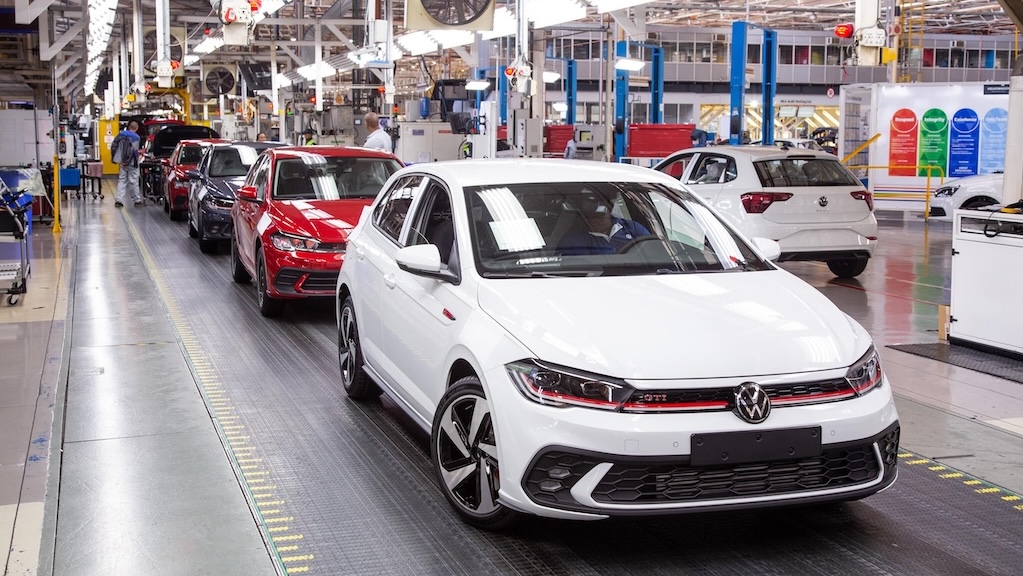
Vehicle manufacturing is a critical industrial pillar, but it relies heavily on Europe. In 2025, 81% of locally built vehicles were exported to Europe and the UK, compared to just 8% sold across the rest of Africa. With these export destinations set to ban new internal combustion engine sales by 2035, NAAMSA modelled a scenario, a risk projection rather than a forecast, warning that failing to shift production could see automotive export values drop from R201.7 billion to R40.3 billion, putting 55 000 of the 110 000 manufacturing jobs at risk. Building local EV production capacity requires a vibrant domestic market to justify the investment.
9. More value from local minerals
South Africa mines key battery and drivetrain inputs, including manganese, platinum group metals and nickel, but exports them predominantly raw. Developing a local EV supply chain allows the nation to capture more downstream value, moving from a raw material price-taker to a value-added manufacturer.
10. A good fit for a grid gaining solar
Because many vehicles sit parked during peak daylight hours, EV charging aligns naturally with solar generation. Managed midday charging uses solar capacity that might otherwise be curtailed. Municipalities are adapting: Cape Town’s optional time-of-use tariff encourages consumers to shift use away from peak periods, allowing vehicle batteries to help balance the grid rather than overload it.
11. Supply security over import vulnerability
Recent refinery disruptions have highlighted energy security risks alongside price spikes. Unplanned stoppages at Sasol’s Natref refinery disrupted jet fuel supplies to OR Tambo, while international export restrictions (such as Russia’s diesel export ban) continue to tighten global availability. Diversifying transport power onto a grid increasingly supplied by domestic renewables and private rooftop solar reduces single-point exposure to oil supply chain shocks.
12. Simpler mechanics and new technical skillsets
Electric drivetrains require far fewer moving components, eliminating oil changes, timing belts and complex exhaust systems while reducing brake wear through regenerative braking. Lower maintenance requirements will affect existing jobs: former trade minister Ebrahim Patel noted that up to 140 000 fuel station positions could face long-term displacement. Proactive planning enables a workforce transition into high-voltage systems maintenance, charger installation and battery repair.
What the numbers don’t show
Three things temper the picture. The sales figures are an undercount: NAAMSA records only brands that report, and Geely and Dongfeng, each with hundreds of EVs sold locally, do not yet. The carbon gain is smaller here than in Europe because most of the grid still runs on coal, although a growing number of owners charge from rooftop solar, and tailpipe pollution in cities disappears either way. And every litre not sold is fuel levy not collected, so the state will eventually need a road-user charge to maintain roads, along with some public support for chargers on routes where operators cannot yet make money.
Published 20 October 2026. ©Justus Visagie | Pictures from QuickPic, MotorPress, Dongfeng, and Pexels