
Sweden’s 99-year-old Volvo Group unveiled its first all-electric extra-heavy commercial vehicles (EHCVs) in 2022, targeting reductions in carbon emissions and noise pollution. Increasingly capable batteries and regenerative braking systems already deliver ranges of up to 300 km on a full charge.
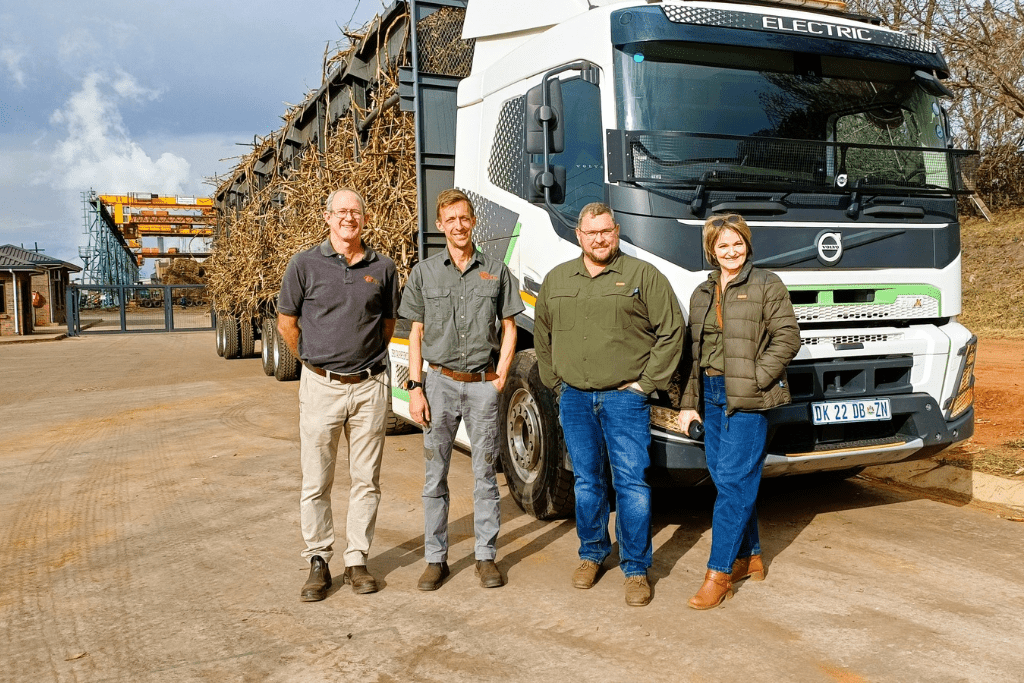
More than 5 700 Volvo electric trucks worldwide have covered a combined 250 million km. Sixteen of them are in South Africa, and since March this year two have each been almost continuously hauling up to 31,5 t of sugarcane at a time to UCL’s sugar mill at Dalton in KwaZulu-Natal.
Five years ago, the mill increased its electricity cogeneration from burning waste bagasse from 5 MW to 9 MW. Once all UCL’s operational requirements are met, about 2 MW of surplus electricity remains.
“We’re always looking for opportunities to use our surplus energy. After a meeting with Eric Parry of Volvo Trucks South Africa, we realised that our cheap surplus power and short-distance haulage requirements were a potentially ideal scenario for Volvo’s electric trucks,” says Clinton Vermeulen, general manager of operations at UCL, a diversified, farmer-owned company.
Matching truck to task
Eric, Volvo’s senior manager of sustainable solutions, says the company’s electric trucks are “the right horses for the job”. Volvo’s advanced simulation programme analysed UCL’s sugarcane haulage in detail and identified the optimal models and configurations for the operation.
“We match the operation to the truck so that there are no range issues. UCL doesn’t need a truck that’s away from base for days at a time. It can therefore manage range, recharging times and costs very precisely and optimally.”
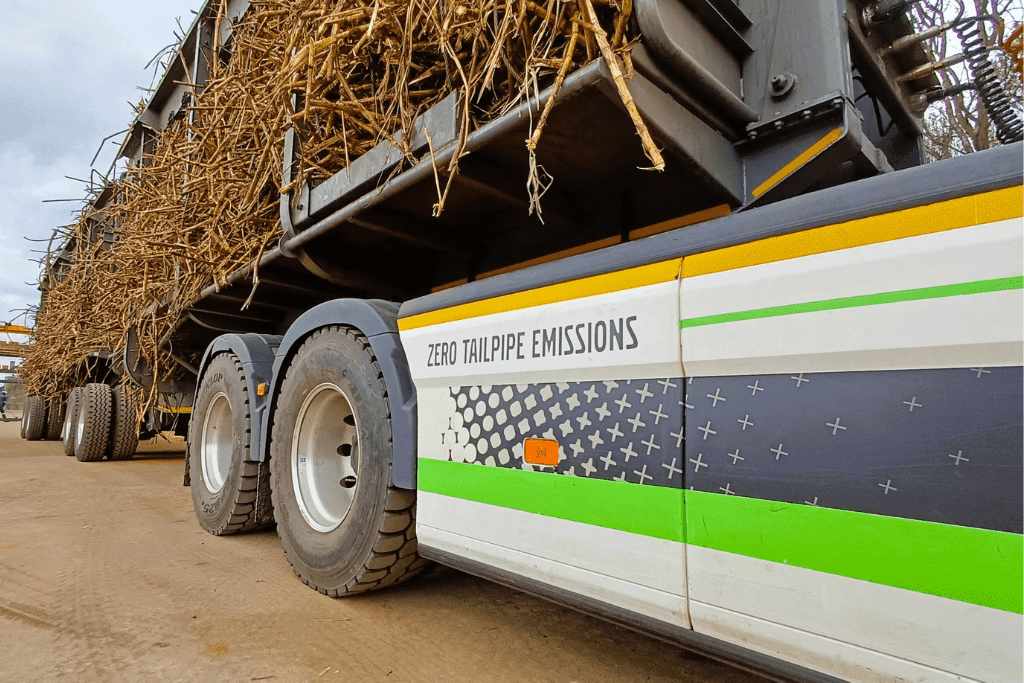
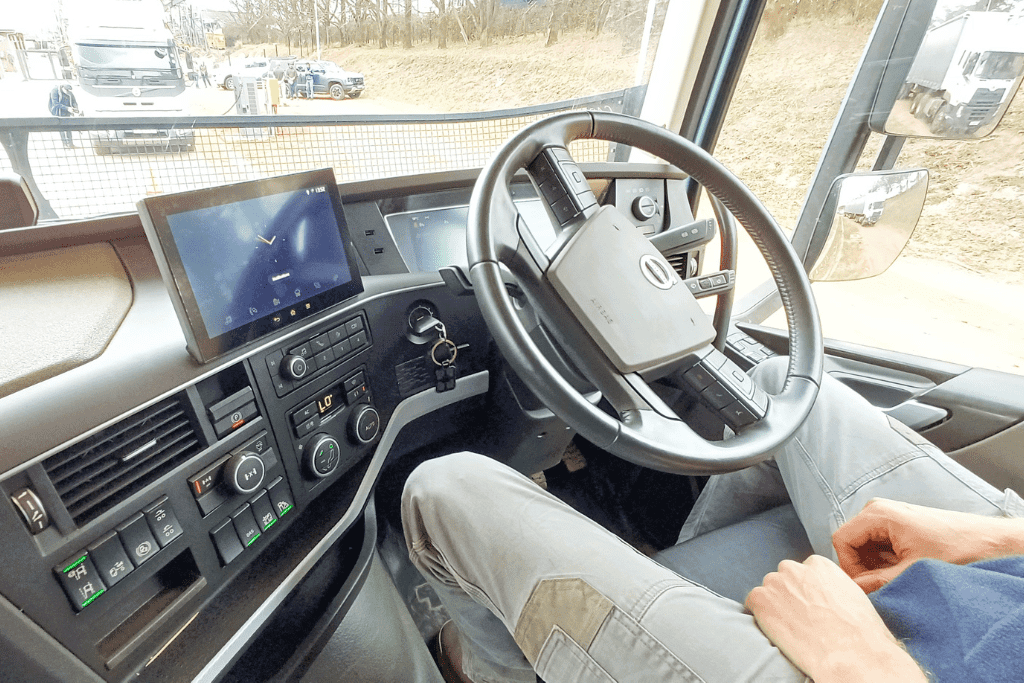
Apart from their power sources and drivetrains, Volvo’s electric trucks are intentionally almost identical to their diesel counterparts. This makes it easier and quicker for a driver to switch to an electric model. “It takes a driver an hour at most to get used to it,” says Eric.
Quiet muscle
After a successful trial, UCL concluded purchase agreements for the Volvo FMX Electric and Volvo FH Electric, both in a 6×4 configuration. Six batteries deliver 540 kWh to three electric motors paired with a 12-speed I-Shift automated gearbox, producing a continuous 490 kW and 2 400 Nm of torque. This comfortably handles a gross combination mass of 56 t.
“Our electric trucks are definitely up to the task,” says Eric.
Clinton says that for the trial UCL installed a temporary 120 kW charging station, which could do a full recharge in 3,5 hours. UCL’s new permanent 240 kW charging station can recharge a Volvo truck’s completely flat pack of heavy-duty lithium-ion batteries in two hours.
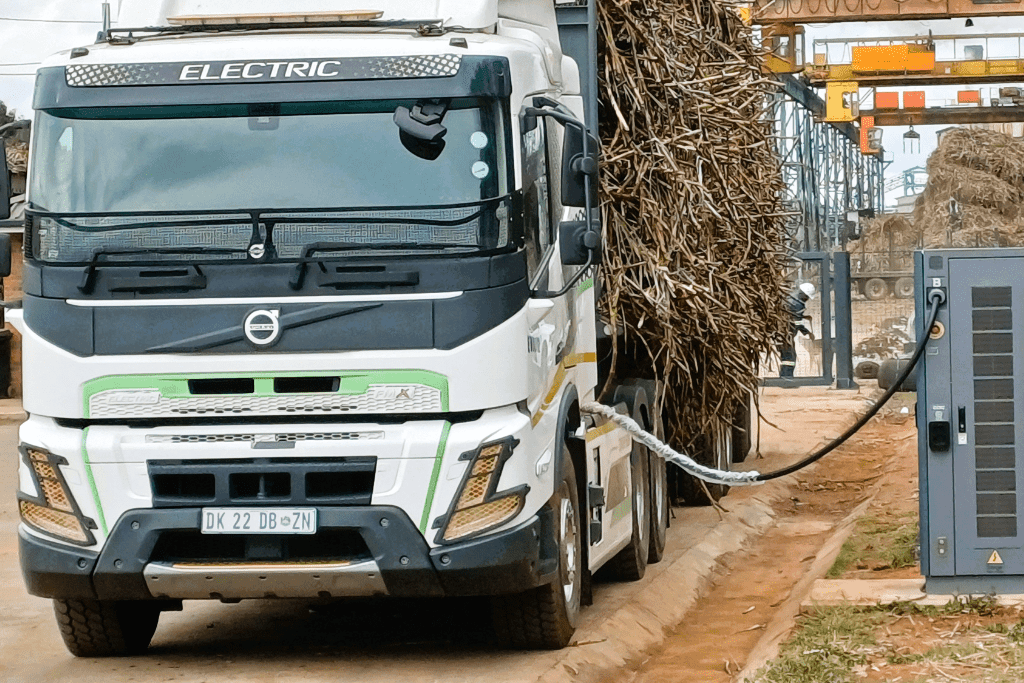
“Our average sugarcane haul distance is 25 km, so a 50 km round trip. The furthest farm is about 65 km from the mill. Hauling sugarcane is heavy work in hilly terrain, so our trucks’ maximum range is about 160 km. Our shorter round trips and regenerative braking on the downhills mean we can do several trips before a big recharge, or small top-ups between trips.
“These high-tech batteries are protected by a built-in thermal management system. They never need deep-cycle charging and can be recharged in small increments at any charge level.”
Savings that stack up
Running 24 hours a day for an average of 29 days a month, each truck can potentially cover 13 000 to 14 000 km a month. The company values the electricity from its cogeneration at R1,60/kWh. At about 1,9 kWh/km (190 kWh/100 km), it costs UCL R39 520 to R42 560 a month to power each truck. Fuel for a diesel truck working in the same conditions costs R209 209 to R245 784 a month.
According to international research, the tailpipe emissions of a typical diesel truck can amount to 19,16 to 22,51 t of carbon dioxide equivalent a month.
While the electric Volvos wait in UCL’s staging area, they can top up their batteries at the nearby charging station, even for as little as ten minutes.
A farmer’s verdict
Neil Wittig, a sugarcane supplier to and shareholder in UCL, is a strong supporter of the company’s Volvo electric truck project. “Electric vehicles are generally 85 to 90% efficient at converting energy into power, whereas a diesel truck is 35 to 45% efficient. Most of the energy in diesel is lost as heat.”
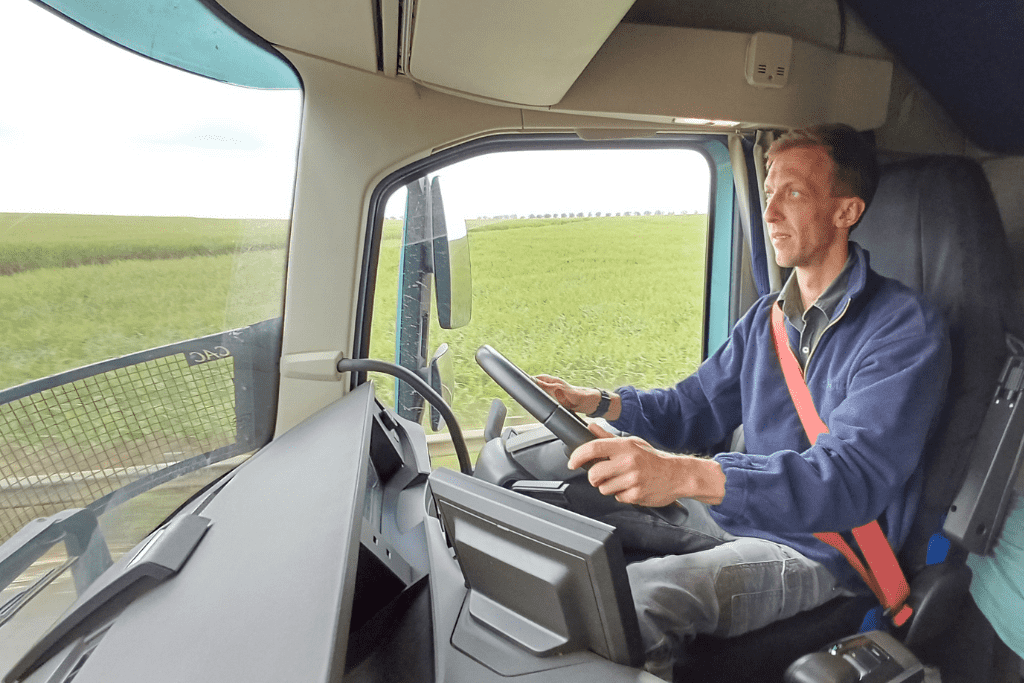
He has completed the conversion training and put both trucks through their paces. “They have more power than a diesel model. On a long uphill, a diesel truck will change down three, four or even five gears, whereas these trucks may change down only two or three. The electric gear changes feel so much smoother. You have continuous power from the moment you change gear.
“It makes the whole driving experience much more pleasant and easy. The more efficient road transport also improves overall turnaround times between the mill and the farms.”
The bigger picture
Clinton points out that Volvo’s electric trucks cost two to three times as much as their diesel equivalents, with correspondingly higher insurance premiums. However, thorough planning by Volvo and UCL, and UCL’s proper implementation of it, deliver returns that far outweigh these costs.
UCL has the advantage of cheap surplus electricity from cogeneration, and a haulage plan in which the trucks constantly return to base and run almost continuously through a nine-month milling season. Volvo’s electric trucks need only one service a year, which also costs less than a diesel equivalent’s.
“The break-even point for us is 50 000 to 60 000 km a year. Our electric sugarcane trucks will cover about 90 000 to 100 000 km a year. If we do 100 000 km, we’ll actually be making money,” says Clinton.
“We’re switching to electric trucks so that our growers can benefit from lower transport costs. UCL hopes to buy at least 15 more electric trucks within the next year. We’ve calculated that 30 to 40 would be enough to haul all the sugarcane in our area to the mill, and we have enough surplus power for them.
“After seeing how well these trucks work, some growers or groups may want to invest in their own trucks and simply recharge at our mill at much better prices than for diesel.”
Neil has two diesel trucks that each work up to 12 hours a day hauling his sugarcane. He is strongly considering selling them and investing in a single electric truck that runs 24 hours a day.
This article first appeared in Afrikaans in Landbouweekblad and is republished with kind permission of Landbou.com. Watch the UCL and Volvo Trucks video here.
Published 9 November 2026. ©Lloyd Phillips | Pictures by the author & Jared Beukes