
Is the Taycan-without-a-suffix a lesser car than its more expensive siblings? Justus Visagie drove it to find out, and discovered that Taycan has a specific talent that very few cars possess.
What is it?
It’s simply called the Porsche Taycan and it occupies the bottom rung on the fully electric model range’s price and performance list. At R2 262 000, this ‘entry-level’ Taycan costs millions less than the apex model of the range. The range-topping Taycan Turbo S will set you back a tear-jerking R4 061 000 (in February 2022). Quite aptly – because it’s the slowest in the series – the Taycan RWD (I’ll call it that to prevent confusion) arrived here last, joining the three model derivatives that arrived before it. These three each drive all four wheels, and can go faster and farther.
In the meantime, the striking Taycan GTS has also arrived, so prospective owners now have five Taycan versions to choose from. There’s an alternative body shape available too, in the form of the Taycan Cross Turismo – a kind of low-slung SUV-type shooting brake estate car.

Design features
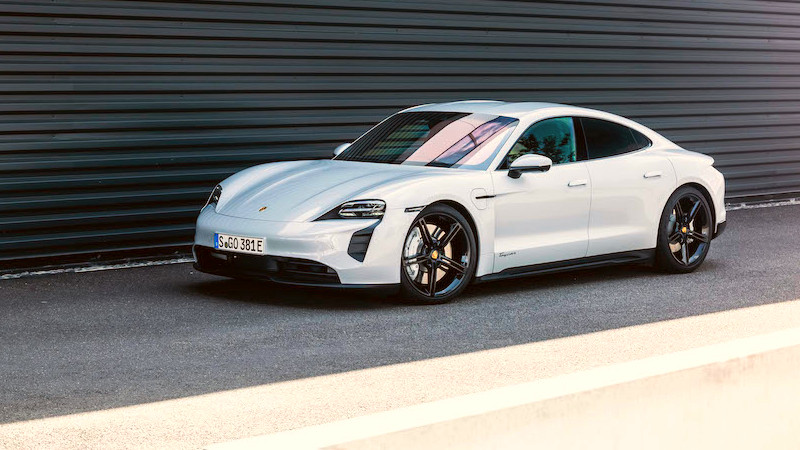
Except for the GTS, the Taycans are fairly conservatively styled, so the Taycan RWD does not look anything like a bargain Porsche. Also, many drivers prefer sports saloons that power the rear wheels only, so it might be seen as a purist’s car superior to its all-wheel-driven siblings.
Porsche says the Taycan RWD wears unique aerodynamically optimised 19-inch Taycan Aero wheels and black anodised brake callipers. But, the mags on our test car was upgraded to beautiful 20-inch “Taycan Turbo Aero Wheels”.
As on the Taycan 4S, the front apron, side sills and rear diffuser are unpainted black plastic, that look much better than the idea might sound.
Apart from its RWD setup and subtle visual differences, the base car is all Taycan: low, with a sharp nose, and a naturally aerodynamic shape gifted by 911’s form. Its cd value of 0.24 (0.22 with optional air suspension that can lower the car) is the lowest of all current Porsche cars and a huge achievement. The Taycan RWD also boasts Porsche Active Aerodynamics (PAA) that open and close adjustable air vents in the nose of the car, and control the variable rear spoiler.

In the cabin
These days, the driver interface of a car can be as significant as the way it drives. This is no 911 GT3 RS but a Benz EQS rival, so app connectivity and the ease of operating the air-conditioning (for example) are important to the car’s success.
Porsche delivers, with what is arguably the best digital interface money can buy, consisting of three screens. Directly in the driver’s line of sight is the attractive instrument screen. It has a curved shape and flat surface, without cowl or overhang. Porsche says it was inspired by the wide and cleanly styled dashboard of 1963’s 911. The second screen, mainly for infotainment, is in the centre of the dashboard, while the third – typically for controlling the air-con and heated seats – sits at an angle below the middle screen and tilted vertically towards the front occupants.
The digital buttons and graphics are sharp and user friendly and the style bordering on subdued. It looks far more dark and serious than the latest Mercedes-Benz interface.

As standard, the Taycan RWD comes with a partial leather interior as well as front “comfort seats” with eight-way electrical adjustment. We love the fact that each front passenger has his or her own knee airbag, a glaring omission in many luxury cars. The cabin is about as spacious as that of an E Class or 5 series, but the occupants sit lower than in the Mercedes-Benz and BMW saloons. The Taycan is a sports car after all, Porsche says.
Unlike the Panamera and Porsche SUVs, but similar to the Cayman, the Taycan RWD has two luggage compartments. There’s a very useful 84 litres at the front, and about 400 litres at the rear.
The Taycan’s interior is damn close to perfect, but the plastic type door sills appear cheap. A Porsche spokesman explained that this is because it’s made from recycled materials to add to its sustainability credentials. For some reason the wipers were a little noisy when in use, and the car only offered Apple CarPlay connectivity. Android Auto compatibility should arrive soon.

Battery and charging
The Taycan RWD has a 79 kWh battery pack (71 kWh usable), which is smaller in size and capacity than those of the other Taycans. For an additional R137 360 the customer can choose the bigger “Performance Battery Plus”, a 93.4 kWh pack, with a usable 83.7 kWh. This extends the RWD model’s range from approximately 300 km to about 400 km, and makes it faster too. As with other battery-electric vehicles (BEVs), a myriad factors influence range – from driving style to the ambient temperature. BEVs don’t like cold conditions, so temperatures below 10 degrees Celsius swallow large chunks of range.
If you buy a new Taycan, Porsche South Africa will supply you with a 22 kW wall charger for your home or office. This will ‘fill’ the battery (if almost empty) in about three hours. Porsche says the wall charger requires a 3-phase electricity supply and has to be installed by an electrician.
Charging in public
Porsche had designed the Taycan to recharge its battery very quickly. The standard battery can accept as much as 225 kW, going up to an impressive 270 kW in the bigger battery. These charge rates are largely irrelevant to South Africans, where the faster public chargers deliver 80 kW. However, in January 2022 Audi South Africa announced its plans to install four 150kW chargers along major highway routes such as the N1, N2, N3 and N4.
Seeing that the current crop of ‘high-speed’ public chargers (at the time of writing) deliver 30 or 60 kW, with only a handful of 80 kW chargers, we’ll use 50 kW as a rough average.
At 50 kW stations, it will take around 90 minutes to charge the smaller battery from 5 to 80 percent. This means one of the new 150 kW Audi/GridCars chargers will need only 30 minutes to do the same.
Range and efficiency
With the optional bigger battery in the test car, a full charge showed a range of 400 km. Most owners, except those with long daily commutes, will only need a full charge once or twice a week, even with the regular battery. It also means Taycan owners can easily go on the sort of day trips sports car driver regularly enjoy, like the 200km loop that joins Helshoogte, Franschhoek pass, Rooiels, and Stellenbosch. Using GridCars high-speed chargers, longer journeys along some of the major highways are possible, but BEV owners are more likely to book a flight and rent a car at their destination.

Performance
The Taycan RWD’s 0-100 sprint time of 5.4 seconds seems lukewarm compared to the 2.8 seconds it takes the ‘quattro’ Taycan Turbo S when using launch-control. But being electric, it feels faster than a slightly quicker combustion car. The baby Taycan is still as exciting as a plutonium-powered De Lorean.
Porsche followed a different approach when it designed the transmission, which sits on the rear axle. Where other BEVs use a single ratio, Porsche created a twin-ratio gearbox. Why? Because first gear gives the Taycan even stronger acceleration from a standing start, while the long second gear “ensures high efficiency and power reserves even at very high speeds,” the company says.
I never noticed when it changed from first to second, so it feels like any other powerful BEV: There’s a flood of strong, relentless torque, while the only sound comes from the air whooshing over the body. Well, almost the only sound, because there is a low-volume sci-fi sound that resembles chatter from Star Wars’ R2-D2. R2 only speaks when the driver floors the pedal. Like Pavlov’s dog, I started to associate it with the funfair feeling of electric acceleration. The Taycan’s top speed is limited to 230 km/h. Using launch control, it will do 0 to 160 km/h in 11.5 sec. and 0 to 200 km/h in 17.6s. Rolling acceleration is fierce, so going from 80 to 120 km/h takes just 3 seconds!

Ride and handling
With the regular battery, the RWD Taycan weighs 2,1 tons; and 2,2 tons with the bigger battery our test car had. It’s a lot, and this limo ain’t no Lotus Elise. Then again the BMW M550i xDrive combustion sedan weighs almost 2 tons, so there’s no reason for fat-shaming the Taycan.
Still, a fat battery and low-profile rubber make a perfect recipe for a crashy, bumpy ride. And this is where it gets interesting: The RWD Taycan’s ride is sublime. Its suspension is so supple and cushioning that it puts most luxury ICE cars to shame, while rolling on big (optional) 20” rims.
To achieve this miracle ride, Porsche uses its 4D Chassis Control system that “analyses and synchronises all chassis systems in real time,” the manufacturer states. It says “both the standard steel-spring suspension of the Taycan and the optional adaptive air suspension with three-chamber technology are supplemented by the PASM (Porsche Active Suspension Management,” a standard feature.
Furthermore, the aluminium housing of the underfloor battery acts as a load-carrying component and forms part of the Taycan’s safety structure. This stiffens the body, which also aids comfort and handling. As is the norm with BEVs, the battery is installed low-down in the car, and in the middle, giving it a very low centre of gravity. These elements make for good handling – but the weight is noticeable. This made me cautious to get anywhere close to the adhesion limits of its tyres.
Verdict
Apart from the noisy wipers, bits of lucky-packet plastic here and there, and the subjectively odd headlight design, there is nothing to fault. Besides helping to reduce air pollution, even when using dirty Eskom power, the Taycan is simply one of the best cars ever built.
Yes, it’s expensive, but a battery that provides so much performance, and a range (per charge) of over 350 km, easily makes up a third of its price. Apart from that, the Taycan must surely count among the top 5 best cars for sale in South Africa.
Thanks to e-mobility expert Carel Snyman for additional reporting.
Porsche Taycan specifications
Price: R2 262 000 (before options, February 2021)
Range: 354 – 431 km (WLTP)
Gross battery capacity: 79.2 kWh (Net 71 kWh)
Max. charge rate: 800V, 225 kW
Consumption: 28 kWh/100 km
Max. power/torque: 300 kW / 345 Nm
0-100 km/h: 5.4 sec
Top speed: 230 km/h
Luggage capacity: 656 – 1 453 litres
After-sales support: 3-yr Driveplan (5 yrs optional) and 2-year warranty
Rivals: Mercedes-Benz EQE, Audi e-tron GT quattro
(Specs from manufacturer)
